Why Can a Lower Monthly Payment Cost More Over Time?

When managing student loans, a lower monthly payment can sound like the perfect solution. It means having more money available for rent, groceries, transportation, and other everyday expenses. For students and recent graduates in the United States, keeping monthly payments affordable can make a significant difference when starting a career.
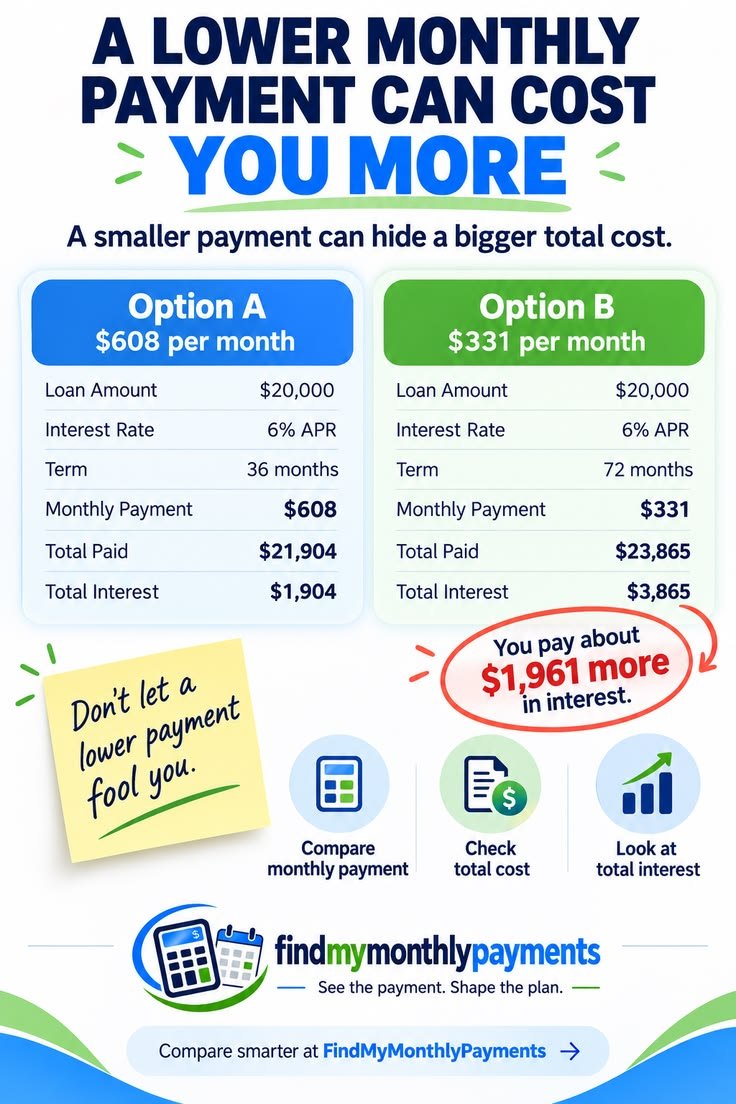
However, there is something important to understand: a lower monthly student loan payment can sometimes lead to paying more money over the life of the loan.
This happens because lowering your monthly payment may extend the repayment period, giving interest more time to accumulate. Although you may save money each month, the total amount you repay could increase substantially.
Understanding how this works can help you choose a repayment strategy that balances your current budget with your long-term financial goals.
In this article, we will explain why lower monthly payments can cost more over time, how interest affects your student loan balance, and what you can do to manage your debt more effectively.
1. How Do Lower Monthly Student Loan Payments Work?
A monthly student loan payment is the amount you are required to pay your lender or loan servicer according to your repayment agreement.
Your payment generally covers interest and reduces your principal balance. The principal is the amount you borrowed, while interest is the cost of borrowing that money.
Several factors influence your monthly payment, including:
- The amount you borrowed.
- Your interest rate.
- Your repayment period.
- Your repayment plan.
- The terms and conditions of your loan.
One way to reduce your monthly payment is to extend the repayment period.
For example, instead of repaying a student loan over 10 years, you might qualify for a repayment arrangement that spreads payments over a longer period.
This can make each monthly payment smaller because the amount owed is divided across more months.
However, interest may continue accumulating throughout the extended repayment period. As a result, you could pay more in total even though your monthly payments are lower.
That is why it is important to look beyond the monthly payment when comparing student loan repayment options.
2. Why Can a Longer Repayment Period Increase Total Interest?
The length of your repayment period plays an important role in determining how much interest you pay.
When you borrow money, interest generally accumulates while you have an outstanding balance. The longer you take to repay that balance, the more time interest has to accumulate.
Consider a simplified example of a student loan with the following details:
- Loan balance: $30,000
- Fixed annual interest rate: 6%
- Repayment method: Fixed monthly payments
You could compare two hypothetical repayment periods: 10 years and 20 years.
Using a standard fixed-payment calculation, assuming monthly interest calculations and no additional fees, the estimates would be approximately:
| Repayment detail | 10-year term | 20-year term |
|---|---|---|
| Original loan balance | $30,000 | $30,000 |
| Annual interest rate | 6% | 6% |
| Estimated monthly payment | $333 | $215 |
| Estimated total paid | $39,960 | $51,600 |
| Estimated total interest | $9,960 | $21,600 |
These figures are illustrative estimates, not quotes for a particular student loan.
The 20-year repayment period lowers the monthly payment by approximately $118. However, it increases the estimated total interest by about $11,640.
This example shows why a lower monthly payment does not automatically mean a cheaper loan.
You may have more flexibility in your monthly budget, but you could spend significantly more money before the debt is fully repaid.
3. How Does Interest Affect Your Student Loan Balance?
Interest is one of the main reasons student loans can become expensive over time.
Depending on your loan terms, interest may accrue daily or according to another specified method. Many student loans calculate interest using the outstanding principal balance and the applicable interest rate.
As you make payments, some of your money goes toward interest, while the remainder reduces principal.
When your principal decreases, the amount of interest that can accrue in the future generally decreases as well, assuming the interest rate and other conditions remain unchanged.
However, when your monthly payment is relatively low, less money may be available to reduce the principal after covering the interest due.
This can slow your progress toward paying off the loan.
For example, imagine that a portion of your monthly payment covers the interest accumulated during that period. Only the remaining amount reduces the original loan balance.
If you make relatively small payments over a long period, you may continue paying interest for many years.
The important point is that a lower payment can make repayment manageable, but it may also slow the rate at which you eliminate your debt.
4. Are Lower Monthly Payments Always a Bad Idea?
No. Lower monthly payments are not necessarily a bad financial decision.
For some borrowers, they are essential.
A recent graduate might earn $40,000 annually while paying rent, buying groceries, covering transportation costs, and building emergency savings. A large student loan payment could make it difficult to meet these responsibilities.
In this situation, a lower payment may help the borrower avoid missed payments and maintain financial stability.
Lower payments may be especially helpful when:
- Your income is temporarily low.
- You are searching for a job.
- Your essential living expenses have increased.
- You have experienced an unexpected financial emergency.
- You need to avoid falling behind on your loan payments.
For eligible federal student loan borrowers, certain repayment plans may adjust payments according to income and other eligibility requirements. Program availability and rules can change, so check current information through Federal Student Aid.
Keep in mind that some income-driven repayment arrangements may involve payment amounts that do not fully cover the interest accruing on a loan. The treatment of unpaid interest and any forgiveness options depends on the applicable program rules.
The goal should not always be to choose the highest possible monthly payment. Instead, choose a payment you can afford while considering the total cost of repayment.
5. What Is the Difference Between Monthly Affordability and Total Cost?
Monthly affordability and total borrowing cost are two different things.
Monthly affordability refers to whether you can comfortably make your required payment while covering your other expenses.
Total borrowing cost refers to the full amount you pay over the life of the loan, including principal and interest, as applicable.
A repayment option can be affordable each month but expensive in the long run.
For example, suppose one repayment plan requires $250 per month while another requires $350.
The $250 payment may leave you with more money for immediate expenses. However, if that plan extends repayment by several years, you may pay more interest overall.
The $350 payment may cost more each month but allow you to eliminate the debt sooner.
Neither option is automatically right for everyone.
Your income, financial responsibilities, emergency savings, and other debts all matter when deciding which repayment arrangement makes sense.
A good financial decision considers both what you can afford now and what you want to achieve over the coming years.
6. How Can You Reduce the Total Cost of Student Loan Repayment?
If you want to keep your monthly payments manageable without unnecessarily increasing your total interest costs, consider the following strategies.
Compare Different Repayment Periods
Before selecting a repayment plan, compare the monthly payment and estimated total interest associated with different repayment periods.
A student loan calculator can help you see how extending or shortening your repayment term may affect your finances.
Do not focus exclusively on the smallest monthly payment. Consider how much you will pay in total.
Pay Extra When Your Budget Allows
If your financial situation improves, consider making additional payments toward your student loan principal.
For example, if your required payment is $250 but you can comfortably afford $300, the extra $50 may help reduce your principal faster when applied appropriately.
A smaller principal balance generally means less interest can accrue in the future.
Before making extra payments, check with your loan servicer to understand how additional money will be applied.
Avoid Extending Repayment Without a Clear Reason
A longer repayment period may be useful when you need immediate financial relief. However, avoid choosing an extended term simply because the monthly payment looks attractive.
First, determine whether the lower payment is necessary to maintain financial stability.
If you can comfortably afford a shorter repayment period without neglecting essential expenses or emergency savings, it may reduce your total interest costs.
Review Your Loan Regularly
Your financial situation can change over time.
You might receive a salary increase, change jobs, or reduce some of your monthly expenses. When that happens, review your repayment strategy to see whether you can afford to pay more.
Regularly checking your balance, interest rate, and repayment progress can help you make informed decisions.
7. Can Refinancing Help You Pay Less Over Time?
Refinancing may help some borrowers reduce their borrowing costs, but it is important to compare the full terms of a new loan.
When you refinance, a lender provides a new loan that pays off one or more existing loans.
If you qualify for a lower interest rate, you may be able to reduce the total interest you pay.
However, refinancing into a longer repayment term could increase your total interest costs even if the new monthly payment is smaller.
For example, a lower rate combined with a much longer repayment period may not produce the savings you expect.
Compare the new interest rate, repayment term, fees, and estimated total repayment amount before making a decision.
Be particularly careful when considering refinancing federal student loans into private loans. You may lose access to federal repayment plans, eligible forgiveness programs, and other federal borrower protections.
Refinancing is a decision that should be based on your overall financial situation, not just the monthly payment.
8. How Can a Student Loan Calculator Help You Make Better Decisions?
A student loan calculator allows you to estimate your monthly payments and understand how different repayment choices affect your finances.
You can enter your loan balance, interest rate, and repayment period to estimate the amount you might pay each month.
You can then compare several repayment scenarios.
For example, you could compare:
- A 10-year repayment period.
- A 15-year repayment period.
- A 20-year repayment period.
The results can show how your monthly payment and estimated total interest change when you extend or shorten repayment.
A calculator can also help you estimate the potential benefits of making additional payments.
These estimates can be useful when preparing a budget or deciding whether a repayment option is suitable for your circumstances.
However, calculator results are not guarantees. Actual costs depend on your loan agreement, payment timing, interest calculation method, fees, and other applicable conditions.
For federal loans, consult your loan servicer and the official Federal Student Aid website for information about available repayment options.
Frequently Asked Questions
Why do lower monthly payments sometimes cost more?
Lower monthly payments may involve a longer repayment period. Because interest can continue accumulating while the loan remains outstanding, extending repayment can increase the total interest you pay.
Is it better to choose a lower student loan payment?
It depends on your financial circumstances. A lower payment can help you cover essential expenses and avoid falling behind. However, if it extends repayment, you may pay more interest overall.
Can I lower my monthly payment and still save money?
Possibly. Your options depend on your loan terms, eligibility, and interest rate. Compare the total repayment cost of different plans rather than assuming the lowest payment will be the cheapest.
Does paying extra each month reduce student loan interest?
Generally, yes, when the extra payment reduces your principal balance. A lower principal balance usually means less interest can accrue in the future.
How can I find the best repayment plan for my student loans?
Review your income, essential expenses, interest rate, outstanding balance, and repayment options. A student loan calculator can help you compare estimated costs, while your loan servicer can explain the terms that apply to your specific loans.
Conclusion
A lower monthly student loan payment can provide valuable financial relief, especially when your income is limited or your living expenses are high. However, reducing your monthly payment by extending the repayment period can increase the amount of interest you pay over time.
The key is to balance affordability with the long-term cost of borrowing.
Before choosing a repayment plan, compare the monthly payment, repayment period, and estimated total interest. If your budget allows, consider making extra payments toward your principal to reduce future interest costs.
Most importantly, choose a repayment strategy that allows you to meet your current financial responsibilities while making steady progress toward becoming debt-free.
Remember: The best student loan repayment plan is not necessarily the one with the lowest monthly payment. It is the one that fits your financial situation while helping you manage the total cost of your debt.