
How Can You Estimate the Cost of College Loans?

Paying for college is a major financial commitment, and student loans can help students cover tuition, housing, books, and other education-related expenses. However, borrowing money for college also creates a financial responsibility that can continue for years after graduation. Before accepting a student loan, it is important to understand how much you may need to repay, how interest affects your balance, and what your monthly payments could look like.
Estimating the cost of college loans can help you make better financial decisions before you borrow. Instead of focusing only on the amount you receive, you should consider the interest rate, repayment period, loan fees, and total amount you will pay over time.
A student loan calculator can make this process easier by showing how different borrowing amounts and repayment terms affect your future payments. In this guide, you will learn how to estimate college loan costs, compare borrowing options, and prepare for repayment.
1. Calculate How Much You Need to Borrow
The first step in estimating the cost of college loans is determining how much money you actually need.
College expenses can include tuition, mandatory fees, accommodation, food, transportation, textbooks, computers, and other essential costs. The total amount depends on the institution you attend, your living arrangements, and the length of your program.
For example, suppose your estimated annual college expenses are $24,000. You receive $6,000 in scholarships and grants and have $3,000 available from savings.
Your remaining funding gap would be:
$24,000 − $6,000 − $3,000 = $15,000
In this example, you may need to find another way to cover $15,000 in education expenses.
However, you should not automatically borrow the entire amount without reviewing your options. You may be able to reduce expenses, qualify for additional financial assistance, or contribute some income from part-time work.
Calculating your funding gap gives you a realistic starting point and helps prevent unnecessary borrowing.
2. Understand the Interest Rate
The interest rate is one of the most important factors affecting the cost of a student loan. It represents the cost of borrowing money and is generally expressed as a percentage of the outstanding balance.
A higher interest rate usually means you will pay more over the life of the loan, while a lower rate can reduce your overall borrowing costs.
For example, imagine you borrow $20,000 and repay it over 10 years.
If your loan has a fixed annual interest rate of 5%, your estimated monthly payment would be approximately $212. At an interest rate of 8%, the payment would increase to approximately $243.
Although the difference may appear manageable each month, the higher interest rate would also increase the total amount you pay over the repayment period.
When comparing student loans, check whether the interest rate is fixed or variable. A fixed rate generally remains the same throughout the agreed period, while a variable rate may change according to the loan’s terms and market conditions.
Understanding the interest rate helps you estimate both your monthly payment and your long-term financial commitment.
3. Consider the Repayment Period
The repayment period is the amount of time you have to repay your student loan.
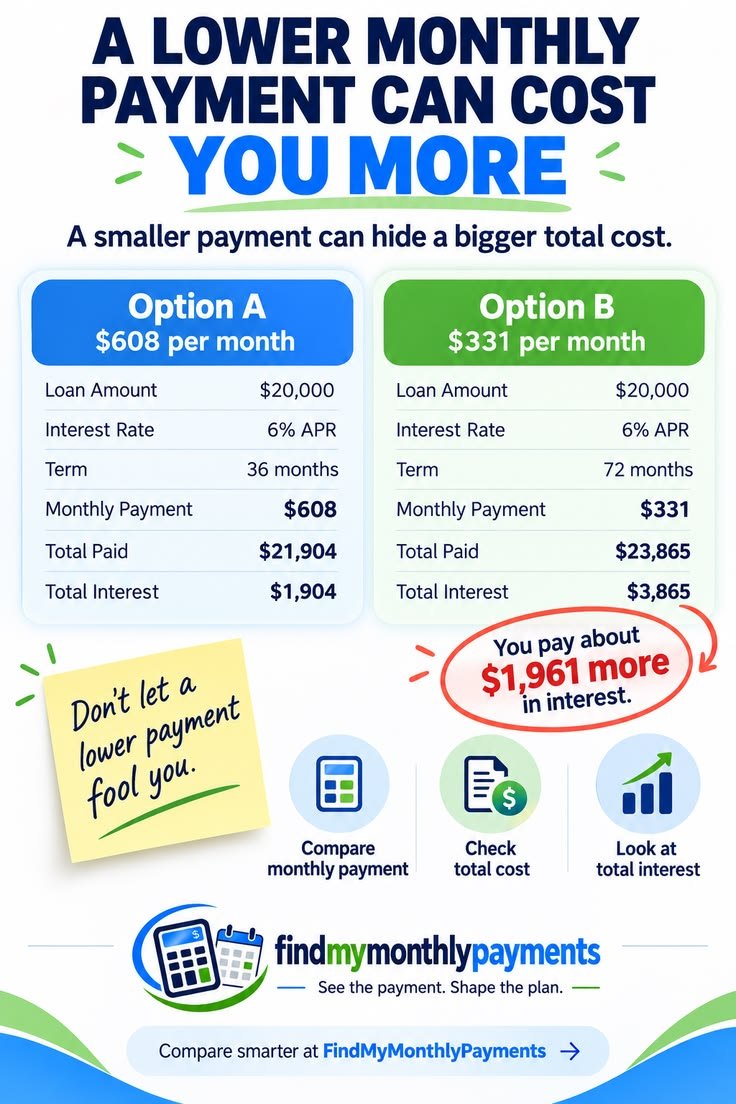
A longer repayment period usually reduces the monthly payment because the balance is spread over more months. However, it can also increase the total interest you pay.
A shorter repayment period generally requires larger monthly payments but may reduce the overall cost of borrowing.
For example, suppose you borrow $25,000 at a fixed annual interest rate of 6%.
With a 10-year repayment period, your monthly payment would be approximately $278. With a 15-year repayment period, it would fall to approximately $211.
The longer repayment period may appear more affordable because the monthly payment is lower. However, you would generally pay more interest over the additional five years.
This is why it is important to compare both monthly payments and total repayment costs.
Choose a repayment period that fits your expected budget without overlooking the long-term financial consequences.
4. Use a Student Loan Calculator
A student loan calculator is a practical tool for estimating the cost of college loans before accepting them.
Most calculators allow you to enter the amount borrowed, interest rate, and repayment period. The calculator then estimates your monthly payment and the total amount you may repay.
For example, suppose you plan to borrow $30,000 at a fixed annual interest rate of 6.5% and repay the loan over 10 years.
Using a standard fixed-payment calculation, your estimated monthly payment would be approximately $341.
Over 120 monthly payments, you would repay approximately $40,920. That includes about $10,920 in interest.
These figures are estimates and assume the full balance accrues interest under the stated terms, with monthly payments beginning under the assumed repayment schedule and no additional fees or changes.
A calculator can also help you compare different scenarios. You might test what happens if you borrow $25,000 instead of $30,000 or choose a shorter repayment period.
By comparing these options, you can identify a borrowing amount and repayment schedule that better match your financial situation.
Remember that a calculator provides estimates rather than guaranteed figures. Your actual costs depend on the loan agreement and how interest is calculated.
5. Include Loan Fees and Other Charges
Interest is not always the only cost associated with borrowing money for college.
Some loans may include origination fees or other charges. These costs can affect the amount you receive or the total amount you must repay.
For example, imagine you need $10,000 to cover tuition and other education expenses. If a loan has an origination fee deducted from the amount disbursed, you may receive less than $10,000 even though the loan’s stated principal is $10,000.
You would need to account for the difference when planning how to pay your college bills.
Before accepting a loan, review the loan disclosure documents carefully. Check the amount borrowed, any fees, the interest rate, when interest begins accruing, and the repayment conditions.
Federal and private student loans may have different fee structures and borrower protections. Compare the actual terms available to you rather than assuming every loan works the same way.
Including fees in your calculations gives you a more accurate estimate of the cost of borrowing.
6. Understand When Interest Begins Accruing
The timing of interest charges can significantly affect the cost of a student loan.
Depending on the type of loan, interest may begin accumulating while you are still in college, during a grace period, or when repayment starts.
For loans where interest accrues during school, the balance may grow even if you are not required to make regular payments at that time.
For example, suppose you borrow $10,000 at a 6% annual interest rate. If simple interest accrues on the full balance for one year, the interest would be approximately $600.
If you borrow additional amounts in later academic years, your total interest costs may increase further.
Some loans may capitalize unpaid interest under specified conditions. Capitalization occurs when unpaid interest is added to the principal balance, potentially causing additional interest to accrue on the larger amount.
The rules depend on the loan type and applicable terms.
Understanding when interest starts and whether unpaid interest can be capitalized will help you estimate the amount you may owe when repayment begins.
7. Estimate Your Monthly Payment Against Your Future Income
Knowing your estimated loan payment is only part of the process. You should also consider whether that payment will be manageable after graduation.
Start by researching realistic starting salaries for your intended career. Then estimate your monthly take-home pay after taxes and other payroll deductions.
Next, account for essential expenses such as housing, groceries, transportation, utilities, insurance, and savings.
For example, imagine your estimated monthly take-home income is $3,200 and your essential living expenses total $2,400. That leaves $800 before student loan payments and other discretionary spending.
A monthly student loan payment of $250 may be manageable under some circumstances, while a payment of $600 could create greater financial pressure.
Your actual situation will depend on your location, employment stability, family responsibilities, and other debts.
It is wise to leave room for emergencies and unexpected expenses rather than using every available dollar for loan repayment.
If the estimated payment seems too high, consider borrowing less, reducing college expenses, or comparing eligible repayment options before committing to the loan.
8. Compare Federal and Private Student Loan Costs
Students in the United States may qualify for federal student loans or may need to consider private student loans.
Federal loans generally offer standardized borrower protections and may provide repayment options based on eligibility and current program rules. Certain federal loans may also have different interest-accrual rules.
Private loans are offered by banks, credit unions, and other lenders. Their rates, fees, repayment terms, and eligibility requirements vary.
When comparing loans, do not look at the interest rate alone. Consider the total repayment cost, fees, whether the rate can change, and the flexibility available if your financial circumstances become difficult.
If you are eligible, review federal student loan options before turning to private borrowing. Private loans may be useful in some circumstances, but they can have fewer repayment protections.
Comparing the full terms can help you identify the option that best fits your needs.
Frequently Asked Questions
How can I calculate the total cost of a college loan?
You can estimate the total cost by combining the principal you borrow with the interest and applicable fees you expect to pay. A student loan calculator can estimate monthly payments and total repayment costs when you enter the loan amount, interest rate, and repayment period.
Does borrowing more money increase the cost of a student loan?
Generally, yes. Borrowing a larger amount usually increases your monthly payment and the total interest you pay, assuming the same interest rate and repayment period.
Is a longer student loan repayment period cheaper?
A longer repayment period generally lowers monthly payments but can increase the total interest paid. Compare the monthly payment and overall cost before choosing a repayment term.
Can I estimate college loan costs before applying?
Yes. You can use estimated tuition expenses, the amount you expect to borrow, and potential interest rates to calculate possible repayment costs before applying. The final figures may differ from your estimates because actual loan terms, fees, and interest rates can vary.
Conclusion
Estimating the cost of college loans before borrowing can help you avoid unnecessary debt and prepare for life after graduation.
Start by calculating your education expenses and subtracting scholarships, grants, savings, and other available resources. Then consider the interest rate, repayment period, loan fees, and the timing of interest charges.
Use a student loan calculator to estimate monthly payments and total repayment costs under different borrowing scenarios. Compare federal and private loan terms carefully, and consider whether your expected income will be sufficient to manage the payments alongside your other expenses.
Most importantly, borrow only what you need and understand the full cost before accepting a loan. Careful planning today can help you complete your education while keeping your future financial responsibilities manageable.